Field notes · Vol. 01

Notes from
the bench.

Practical thinking on the details that decide whether a case fits. Written by the designers who sign the files — no theory without a bench test.

Six notes Updated Oct 2026 12 min average read

Ready when you are

Send the scan.
We’ll take it from here.

Your first unit is on us. See the margins for yourself — no subscription, no setup, no borders.

  • First unit free
  • No card required
  • 24h standard
  • 60+ countries

Field note · Marginal fit

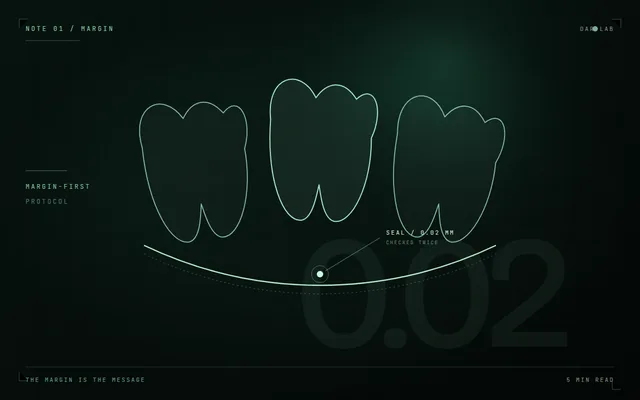
The margin is the message

A restoration can look perfect in a render and still fail in the mouth for a reason you can measure in microns. The margin is where the design meets biology. It is also the first place a clinician inspects when the box opens.

The number is not the point

We aim for a marginal gap around 20 µm, but the number itself is a by-product of something more useful: a margin that is continuous, visible, and designed for the material that will sit on it. A beautiful 18 µm reading on an unsupported shoulder is not a win.

Zirconia and lithium disilicate behave differently. A shoulder that works for one can leave unsupported ceramic on the other. The finish line has to be negotiated with the material, the cement, and the clinician’s prep — not with a target number on a screen.

If the margin is not legible in the file, it will not be legible in the mouth.

Checked twice, by two people

Every case gets a designer check at the bench and a second QC pass before delivery. We zoom to the margin at 10×, confirm the finish line is continuous around the full circumference, and check that the insertion path does not drag the margin across the prep.

None of this is glamorous. It is the quiet part of digital dentistry that decides whether the chair time was worth it. The margin is not a detail at the end of the workflow. It is the argument the whole case has to win.

Field note · Milling

Designing for the mill, not the screen

The screen rewards shape. The mill rewards geometry that can survive a burr, a sinter, and a seating appointment. Those are not always the same design.

Wall thickness is a budget

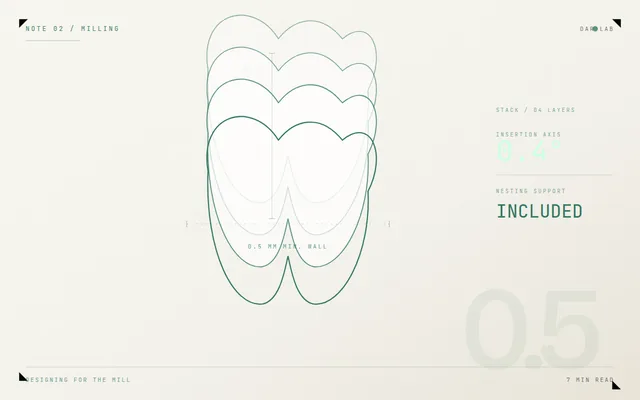
We treat minimum wall thickness as a budget, not a suggestion. Zirconia connectors need volume — roughly 3 mm² anterior and 4 mm² posterior — while lithium disilicate asks for a different approach to the incisal and cervical areas. A connector that looks generous in perspective can be thin in section.

The second constraint is the insertion axis. A path that looks acceptable on a two-dimensional cross-section can trap the unit against an adjacent tooth. We rotate the model, check the draw from the actual seating direction, and look for undercuts that the render hides.

Support is part of the design

Nesting support is not an afterthought. It belongs away from the margin, away from a contact, and thick enough to hold the unit without becoming a second restoration to cut away. On thin crowns, the difference between a clean seating and a chipped edge is often where the support touched down.

We render every case, but we do not design for the render. The file has to be manufacturable by the lab that receives it, on the machine that will actually cut it.

A milled unit has to be beautiful in the hand, not just on the monitor.

That is why our QC sheet includes a manufacturing pass, not only an aesthetic one. If the design cannot be milled cleanly, it is not finished — no matter how good the screenshot looks.

Field note · Scan data

What a scan can’t tell you

An intraoral scan is an extraordinary record of surfaces. It is not a clinical history. The file can tell us where the tissue was on the day of the scan. It cannot tell us why the patient is back, what the last restoration failed to do, or which tooth the clinician is using as the reference.

The data gap

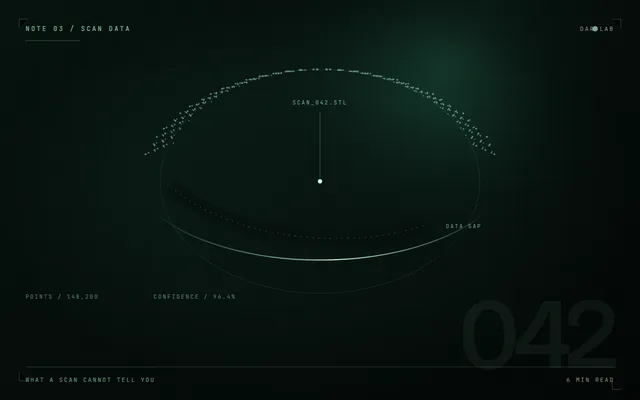
Stitched areas, mobile tissue, saliva, and the lingual of a deep prep can all produce a surface that looks complete but is not. The software fills the hole with a smooth prediction. That prediction is not anatomy. It is a guess with a nice surface normal.

We mark regions of low confidence and ask before we fill them. A scan that reads 96% confidence is not a license to invent the missing 4%. The cost of one question is minutes. The cost of one wrong assumption is a remake.

The best scan in the world cannot answer a question nobody asked.

What we ask before we design

Which tooth is the reference? Is the bite reproducible? Is there a provisional or a previous restoration we should respect? Is the tissue stable, or are we designing through an healing abutment? The questions are short. The answers shape every decision that follows.

Good scan data is the beginning of the case, not the whole brief. The designer’s job is to know the difference.

Field note · Shade

Reading shade in a digital file

A shade tab photographed under a chair light is not a color standard. It is a photograph of a tab under a chair light. Between the camera, the screen, and the ceramic, there are at least three places for the shade to drift.

Calibrate the chain, not the photo

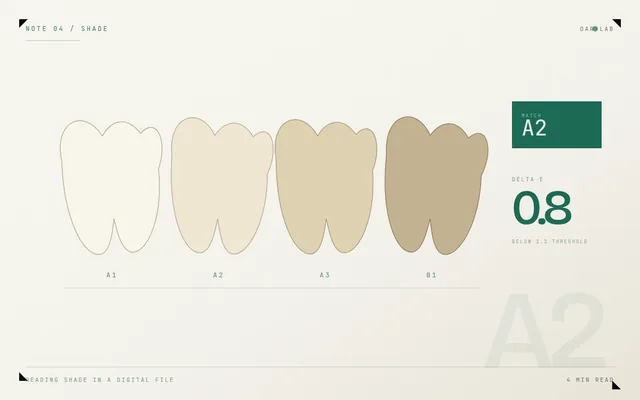
We ask for a shade tab in frame, a gray card, and consistent lighting across the series. That gives us a reference for white balance and a way to compare the incisal, body, and cervical tones without guessing. A calibrated photograph is not perfect, but it is honest.

Even then, a digital shade is a starting point. The final match depends on the ceramic system, the layering strategy, and the thickness of the restoration. A2 in a thin monolithic crown does not read like A2 in a layered veneer.

Match the material, not the monitor.

Where the lab takes over

Layered ceramics build value from the inside. We use the photograph to choose a direction, then rely on the material and the technician’s eye to finish it. The goal is not a perfect screenshot. It is a restoration that disappears in the face.

If a shade looks right on a screen but wrong in the mouth, the screen was never the standard. The face is.

Field note · Occlusion

Occlusion in motion

A bite registration captures a moment. The mouth lives in motion. Designing only to the static contact is like designing a door that works only when it is closed.

Three movements, one design

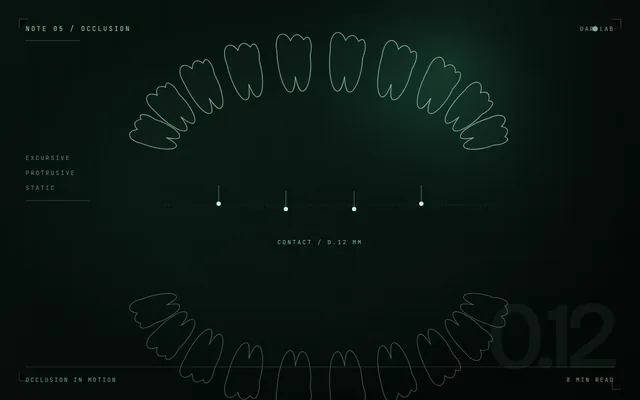
We check centric, protrusive, and lateral excursions. Each one asks a different question of the restoration. Centric asks whether the load is shared. Protrusive asks whether the anterior guidance is smooth. Lateral asks whether the canines and posterior teeth clear without a collision.

Contact patterns should guide, not lock. A contact that is perfect at rest can become a premature interference the moment the jaw slides forward. The design has to account for the path, not just the endpoint.

A contact that is perfect at rest can be a collision in function.

Designing a path, not a point

We use the virtual articulator to map the envelope and adjust the occlusal surface until the excursion is clean. That often means removing material that looked correct on the static view. It is easier to do that in the file than in the chair.

If the design cannot explain its own excursion path, it is not finished. The patient will find the interference long before the follow-up appointment does.

Field note · Retention

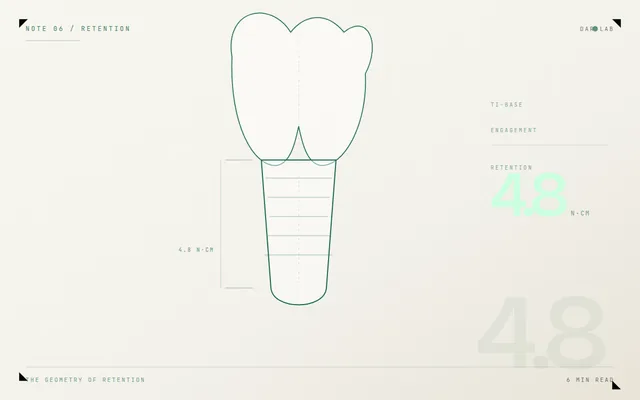
The geometry of retention

Retention gets treated as a value in a software field. In practice it is a relationship between two surfaces, shaped by convergence, surface area, and the path they travel together.

Where the shape does the work

A well-designed crown retains through convergence, surface area, and a margin that seals. The taper has to be enough to seat without binding, but not so much that the restoration depends on cement to stay. The preparation and the design have to agree on the same axis.

For implant cases, retention comes from the connection and the abutment geometry. A ti-base screw channel, a custom abutment, and a crown that seats fully are three separate interfaces. Each one can introduce a gap the others cannot close.

If you need to add retention cement to make it stay, the design is already asking for help.

Testing before delivery

We check the insertion path, the fit, and the resistance form before the file leaves the lab. On screw-retained cases, we confirm the channel alignment and the emergence profile against the scan. On cemented cases, we look for a path that seats without scraping the margin.

Retention is quiet. You notice it when it is missing. The best compliment a restoration can receive is that nobody talks about how it stayed on.