Selected work · Vol. 01

Cases that came
back right.

Six recent partnerships, from a single central to a full-arch conversion. Real cases, shared with permission — including the problem, the design decision and the number that changed.

Six case studies 2025–2026 Five disciplines

01 The archive

Six cases.
One standard.

Every card opens the full case: the problem we were handed, the design decision that changed it, and the result the clinician could measure.

6 case studies Problem · Solution · Results

Labs & companies

Labs we’ve worked with.

Five teams across five countries — a snapshot of the labs and companies we design with. The network is bigger; these are the ones we can name today.

  • Nordic Dental Lab Oslo · Norway
  • Aster Prosthetics Dubai · UAE
  • Meridian Studio Toronto · Canada
  • Kowalski Lab Warsaw · Poland
  • Sable & Co. Mexico City · Mexico

Ready when you are

Send the scan.
We’ll take it from here.

Your first unit is on us. See the margins for yourself — no subscription, no setup, no borders.

  • First unit free
  • No card required
  • 24h standard
  • 60+ countries

Case study · Full arch

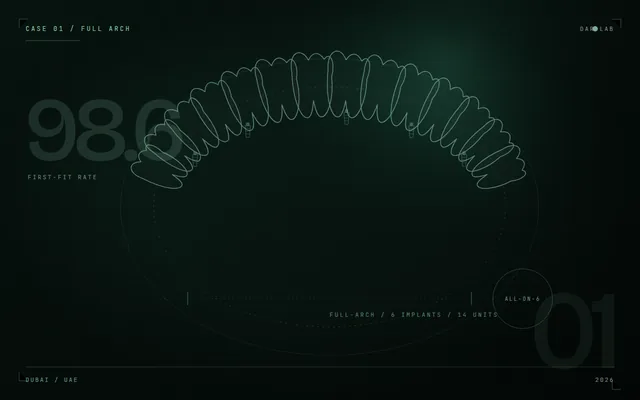
A four-chair clinic, back to same-day arches.

Problem

The clinic ran four chairs and a steady stream of All-on-6 referrals. Margins were inconsistent across designers, and three remakes a month were eating chair time and lab credits.

Solution

We standardized the scan protocol, built a custom abutment library for their implant system, and assigned one senior designer to every full-arch case. Each file now passes a 14-point check before it leaves the lab.

Tech stack
  • exocad
  • Medit Link
  • Ti-base
  • 3Shape
“The margins are the cleanest we’ve received from an outside team. We stopped re-checking every file.” Dr. Lina Haddad · Prosthodontist, Dubai

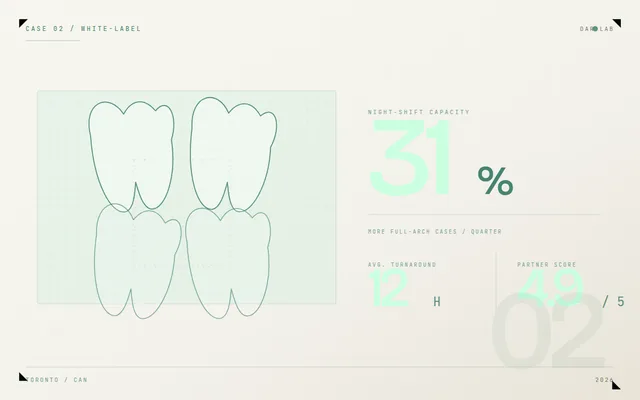
Case study · White-label

A night shift without hiring one.

Problem

A boutique lab was turning away full-arch work because every case arrived after 6pm and needed a designer overnight. Hiring a second shift was not viable for the volume.

Solution

We set up a dedicated white-label pod in Toronto’s time zone, standardized the brief, and introduced an 8-hour express lane for single-unit and bridge work. The lab kept its brand; we stayed behind the scenes.

Tech stack
  • exocad
  • Open STL
  • 3Shape
  • Zirkonzahn
“Dar gave our lab a night shift without hiring one. We send full-arch cases at 6pm and they’re back before our first pour.” Mark Ellison · Owner, Ellison Dental Studio, Toronto

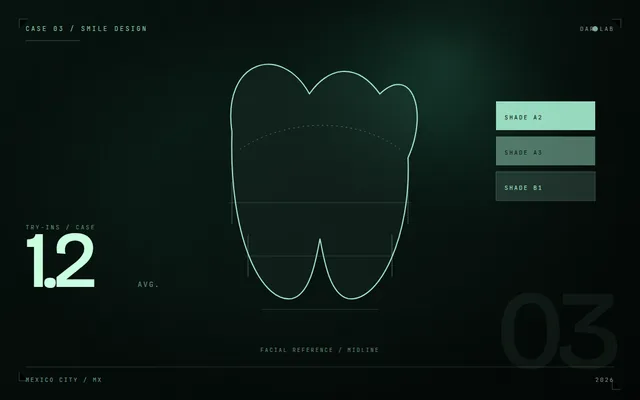
Case study · Smile design

Fewer try-ins. Better first impressions.

Problem

Veneer cases were averaging 2.1 try-ins. Shade and proportion decisions were being made in isolation, and the extra chair time was adding up for the clinician and the patient.

Solution

We moved to a facial-reference workflow: calibrated photographs, a digital midline, and a layered mockup protocol. The design was reviewed against the face before the first try-in, not after.

Tech stack
  • 3Shape
  • e.max
  • exocad Smile Creator
“The mockup matched the face, not just the photos. We stopped guessing at the second visit.” Dr. Sofia Reyes · General dentist, Mexico City

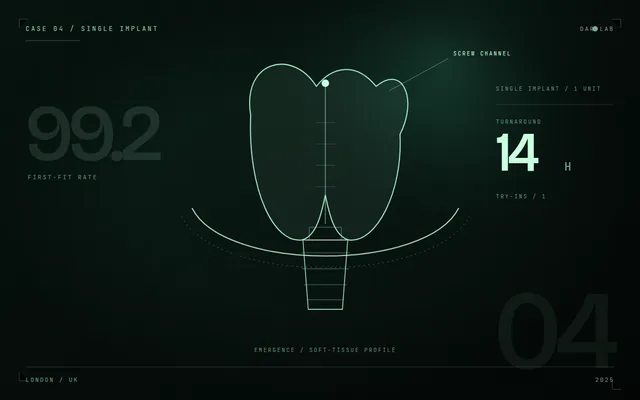
Case study · Single implant

One central, no compromise.

Problem

A single central incisor is the least forgiving unit in the mouth. The patient had a high smile line, a thin labial plate, and a provisional the tissue had already accepted. The previous design sat bulky at the emergence and left a shadow at the margin.

Solution

We scanned the provisional in place, designed a custom titanium-base abutment, and built the emergence profile from the tissue contour rather than the implant platform. The crown was layered zirconia with a lingual screw channel, checked against the opposing arch and the smile line before delivery.

Tech stack
  • 3Shape
  • Ti-base
  • zirconia
  • exocad
“The tissue stayed calm. For a central, that is the whole case.” Dr. Amara Okafor · Prosthodontist, London

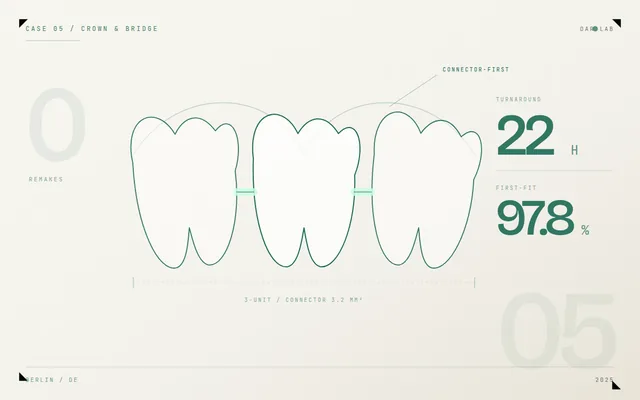
Case study · Crown & bridge

A three-unit bridge that fit the first time.

Problem

A three-unit anterior bridge had already been remade twice. The span was long, the interocclusal space was tight, and the connectors had been designed by eye. The patient was losing confidence in the process.

Solution

We started with the connector, not the crowns: a minimum cross-section sized for the material, an insertion path checked from the actual seating direction, and a pontic shaped for hygiene. Occlusion was verified in protrusive and lateral excursion before the file was released.

Tech stack
  • exocad
  • e.max
  • Medit
“Third time was the first time it seated without a fight.” Dr. Jonas Weber · General dentist, Berlin

Case study · Guides & appliances

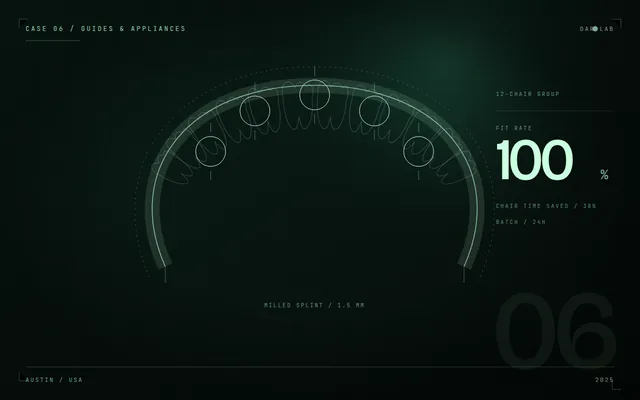
Twelve chairs, one night-guard protocol.

Problem

A 12-chair group was buying night guards from three different labs. Scan quality varied by site, borders were inconsistent, and roughly one in five guards came back for an adjustment — all of it landing on clinical time.

Solution

We rebuilt the intake around one scan protocol, a single bite-registration method, and a shared design standard for thickness, borders and occlusion. Cases now arrive in batches and leave with a QC sheet that every site can read.

Tech stack
  • 3Shape
  • Splint Studio
  • milled PMMA
“The chair time we got back was the real result. The guards are quieter than the old ones, too.” Dr. Priya Raman · Clinical director, Austin